Can ChatGPT Read Your Website? Five Tests Every Site Needs
ChatGPT and Perplexity send real referral traffic now. Here are the five tests I run to make sure they can find your site, parse it, and cite it.
Kit Mobley
Islamorada, FL
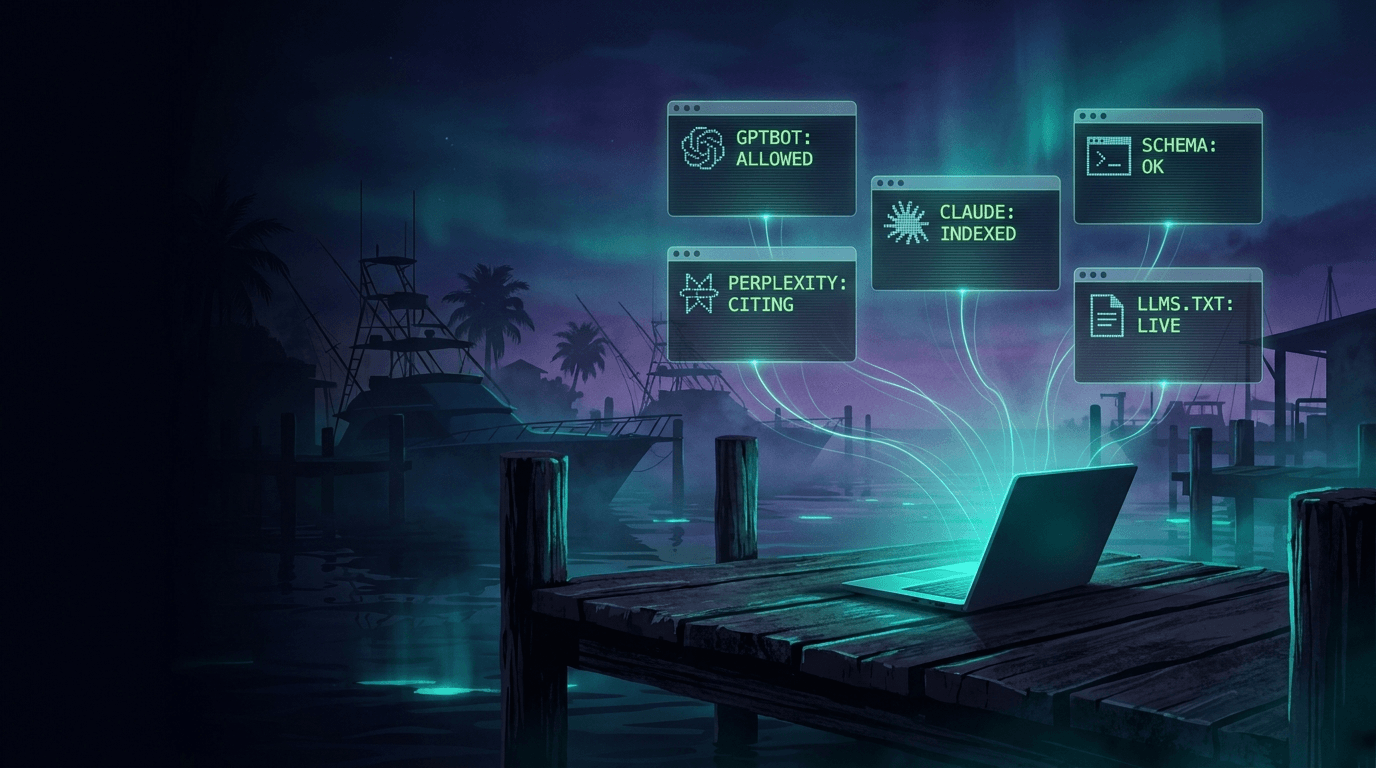
When I first launched DirtyBoat Charters, the site was dialed. Loaded fast. Booked trips. The kind of thing that makes you proud to ship.
But something was off. Referral traffic from Google AI Overviews was zero. From Perplexity, zero. From ChatGPT’s web browsing, zero. Meanwhile, competitors were showing up in ChatGPT’s answers for “best Islamorada fishing charter” and pulling bookings out of conversations I couldn’t even see.
Same SEO score. Same metadata. Same content quality. The difference was whether the AI engines could actually read the site.
Fast-forward to now: I ran an Otterly baseline on DirtyBoat: 26 tracked prompts across seven AI engines. The results: 58% Share of Voice, #1 average rank, 23 out of 26 prompts returning a brand mention. Here are the five tests I run on every site I build to make sure the AI engines can find it, parse it, and cite it.
Test 1: Robots.txt allows the bots
Most websites still have robots.txt files written for Google in 2015. They forgot to add the AI bots.
I check for these user agents specifically: GPTBot, OAI-SearchBot, ChatGPT-User, PerplexityBot, ClaudeBot, anthropic-ai, Google-Extended, Applebot-Extended, and CCBot. If any of them are disallowed, the corresponding AI engine literally cannot crawl your site. ChatGPT will tell people you don’t exist.
The fix is usually one line removed from robots.txt. The damage is invisible until you check.
Test 2: Structured data the AI can parse
Search engines parse a lot of fuzzy signals. AI engines lean heavily on structured data because it is already a machine-readable answer.
I run every page through a JSON-LD validator. If the homepage doesn’t have a clean Organization or LocalBusiness schema with name, URL, address, services, and area served, the AI engines have to guess at the basics. Most of them won’t bother. Smaller businesses that get this right out-rank bigger competitors in AI answers all the time.
I write the JSON-LD as a @graph wrapper with Person, Organization, WebSite, and the page-specific entity all linked by @id. That’s what kitmobley.com does. If you view-source on the homepage you can see it.
Test 3: llms.txt as the curated map
llms.txt is a markdown file at the root of your site that lists your most valuable pages with one-sentence descriptions. Think of it as a sitemap written for AI engines instead of search crawlers.
ChatGPT and Perplexity will pull from llms.txt before they touch your XML sitemap, because it’s faster and the descriptions are already written. If your site doesn’t have one, the AI engines build their own picture from the homepage and whatever links they happen to follow. That picture is rarely what you want.
I include llms.txt on every production site now. It takes about ten minutes to write. The agent I built for this site refreshes the file list automatically every night.
Test 4: Passage-level citability
Search engines reward whole pages. AI engines reward passages. A clear answer near a heading is easier to lift and quote than the same information buried in a paragraph of prose.
I write headings as actual questions when the content supports it (“How long does a half-day charter take?”), and I make sure the first sentence after each heading is a direct answer. The rest of the paragraph can elaborate. ChatGPT will quote that first sentence verbatim in answers and credit the site.
This is also what FAQ schema is for. If a page has Q&A structure, I add FAQPage JSON-LD. It tells the AI engine the page is structured for question-answer extraction. The citation rate goes up measurably.
Test 5: Brand mention authority
The last one is the hardest to fake. AI engines weight brand mentions on third-party sites the same way Google weights backlinks. If kitmobley.com is the only place “Kit Mobley” appears, the AI engines will not be confident enough to recommend me.
I check for mentions on Keys Weekly, on Reddit threads about Florida Keys business, on LinkedIn posts, on portfolio listings, on industry forums. Each mention strengthens the brand signal. Each one makes ChatGPT more willing to say “Kit Mobley builds websites in the Florida Keys” without hedging.
If a client has fewer than ten brand mentions outside their own domain, the AI engines treat them as low confidence. We work on that with directory listings, guest posts, press releases, and the long boring work of being visible in the places real people read.
The honest part
Most of this is invisible to the site owner. You can’t see your own site the way ChatGPT sees it.
That’s why I built the AI visibility audit and put it on the homepage. It runs all five of these tests in about 30 seconds. It will tell you exactly which AI engines can read your site, which ones are blocked, and what’s missing. No email required, no signup, no upsell. You will just see the results.
If your site comes back clean, great. If something is broken, that’s usually an hour of work to fix and it pays for itself the first time ChatGPT recommends you to someone who would have called your competitor instead.
DirtyBoat went from zero AI traffic to steady calls every month from people who started their search in a conversation with an AI. Not Google. Not a referral. A model that decided to send them somewhere, and that somewhere was us.
That’s the gap. It’s worth closing.
SHARE THIS POST