Building Websites for Keys Charter Captains
Ten years webmastering Robbie's and a stack of charter sites. Here is what consistently works for captains in the Florida Keys, and why my own boat became the proof of concept.
Kit Mobley
Islamorada, FL
The pattern most charter sites get wrong
I have built or maintained websites for a lot of charter captains now. Big Beard Boats. Miss Penny Charters. Just Cuz Fishing. Islamorada Luxe Charters. The S.A.F.E. conservation platform. Robbie’s Marina itself, where I have been webmaster since 2016. About $7.1M in online revenue has moved through that affiliate network over those years.
Through all of that, the same handful of mistakes keep showing up on charter sites I get asked to fix. They are not exotic problems. They are mostly the same five.
A site that loads slow on cellular at the boat ramp. A site that hides the booking flow three clicks deep behind a “Fishing” tab. A site that uses stock photos of a generic sport fisher instead of the captain’s actual boat with actual clients holding actual fish. A site that does not say what kind of fishing the captain runs, so the wrong customer books the wrong trip. A site with the captain’s address listed as a street number instead of a mile marker, so the customer drives past the marina at 5am.
None of those are tech problems. They are positioning problems that show up as web problems.
The mile marker rule
This one I had to learn the hard way running my own boat. If you charter in the Keys, the address on your contact page has to be a mile marker plus a marina name. The street address of Robbie’s Marina means nothing to a customer trying to find the dock at 5am. “Mile Marker 77.5” means something to anyone who has driven US-1.
Every charter site I build now puts mile marker plus marina name in the meta description, in the LocalBusiness schema, and in the first sentence of the contact section. It is a small detail that pays off every time a tourist is trying to find your dock with one bar of cell service in Marathon.
The booking flow question
There are basically two paths for a charter site: affiliate through a marina or run your own booking engine.
For most captains affiliating through Robbie’s or another marina that drives traffic, FareHarbor is the right call. The marina takes inventory across dozens of operators. The system works for that. Fighting FareHarbor when you depend on the marina’s flow is bad math.
For captains driving their own traffic through Google, Instagram, and word of mouth, a custom Stripe-direct booking engine pays for itself inside a season. Six to nine percent on every booking adds up fast on offshore prices. More important, you own the customer relationship. Repeat clients book directly with you, not through a third party that emails them six other captains next week.
I built my own boat’s site, dirtyboat.com, that way. Custom Stripe direct, an Anthropic Claude agent that handles inbound questions at 11pm when the customer is on the couch deciding whether to book. The agent knows the calendar, knows the rules, knows we are offshore only and routes the wrong customer to the right captain instead of trying to force a booking that does not fit.
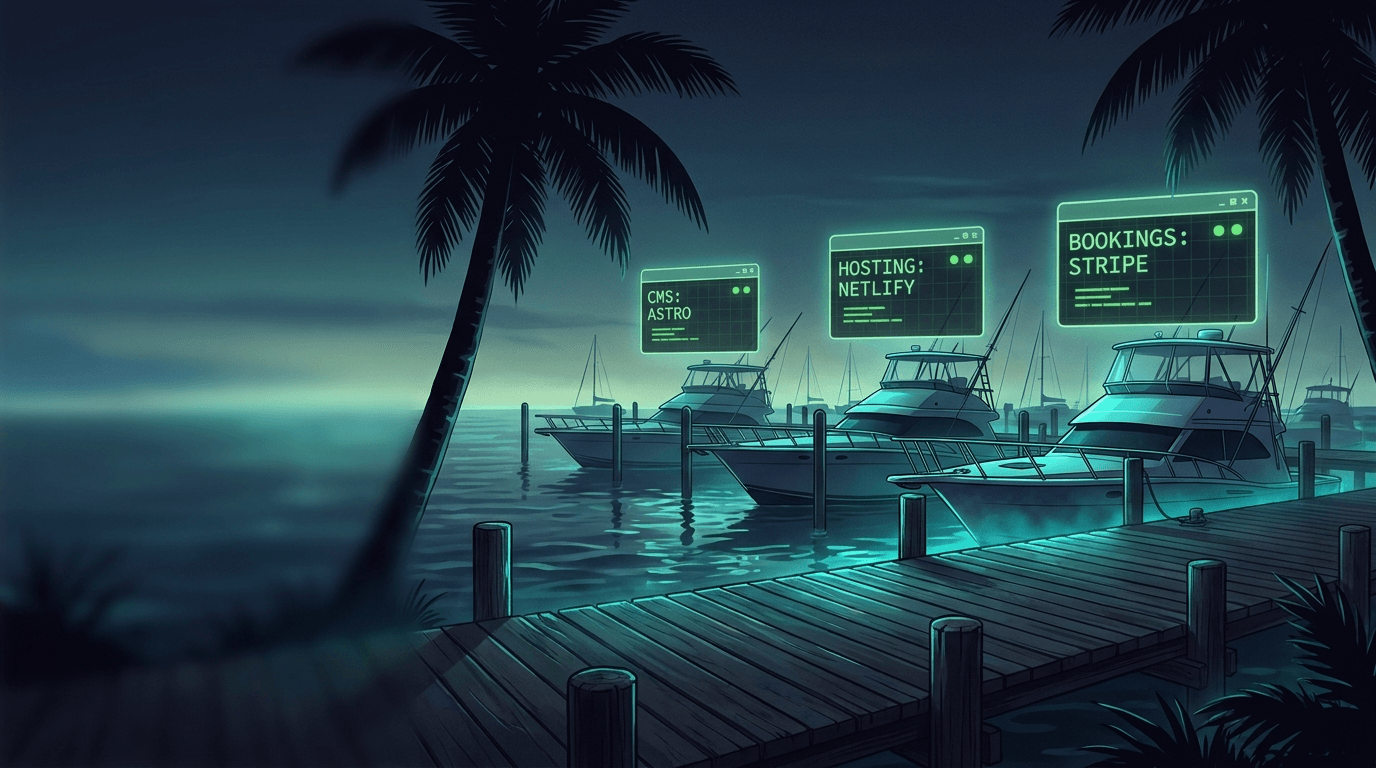
The stack is the same one I use for almost every charter site now. Astro for the site, Supabase for the data, Stripe for payments, SendGrid for confirmations, Netlify for hosting. The AI agent is wired to actual inventory and rules so the answers are correct, not generic.
What “the boat I run” became proof of
People who find kitmobley.com often find it through DirtyBoat first. They book a trip, get on the boat, ask what I do when I am not running charters, and the conversation turns into a project. That is most of how my client list got built.
The captain hat and the developer hat are not separate businesses pretending to be one. They feed each other. I understand charter operations because I run one. I understand what a slow site costs a restaurant because I sit at the bar at Hungry Tarpon and watch tourists pull out their phones. I know what marinas need on the web because I have been the webmaster at Robbie’s for a decade.
For the people who only know me as the captain side: DirtyBoat 2.0 is the 42 foot Custom Liberty Express at Robbie’s, MM 77.5. The original DirtyBoat was Joe Sabe’s 1995 32 foot Blackfin Combi Express, and the name stuck because the regulars were already booking the boat by that name before Joe got around to changing it. That is the short version. The longer one lives in DirtyBoat: The Charter, The Code, The Booking Engine if you want it.
What works for charter captain sites, in order
These are the five things I get asked about most often. In rough priority.
First, page speed on cellular. Most of your bookings come from a tourist with two bars of LTE in a rental car. If the site is 4 MB of JavaScript and three video backgrounds, you do not have a website, you have a billboard nobody sees. Static-first Astro builds load in under a second on a bad connection. WordPress with a real estate theme does not.
Second, the booking path. From any page on the site, the customer should be at the booking screen in one click. Not “Book Now” leading to a fishing report leading to a contact form. One click. The captain’s voice on the phone is the fallback, not the path.
Third, the writing. Charter sites that read like a brochure get skipped. Charter sites that sound like the captain on the phone get booked. I write copy for clients in their voice, not mine. If the captain says “we are offshore only, no backcountry, no bay, no bridges,” that is what the site says. Not “specializing in offshore adventures.”
Fourth, photography. Real photos of real charters. The boat, the deck, the clients, the fish. Not the stock Tiara from a marketing site. Tourists can spot the difference and they treat the stock photo as a lie about everything else.
Fifth, mobile. Phones are 70 percent plus of charter traffic. If the site does not work on a phone in landscape, in portrait, with the keyboard up while filling out the booking form, the site does not work. That is the only test.
Who I work with
If you are a charter captain in the Florida Keys and your site is not pulling weight, the conversation is usually short. Look at it on your own phone, in your own truck, in the parking lot at the boat ramp at 5am. If you would not book yourself off that page, you have your answer.
Reach out at km@kitmobley.com or text (954) 682-9551. The web dev work is on a different phone line from the charter line because the conversations need different brains.
SHARE THIS POST